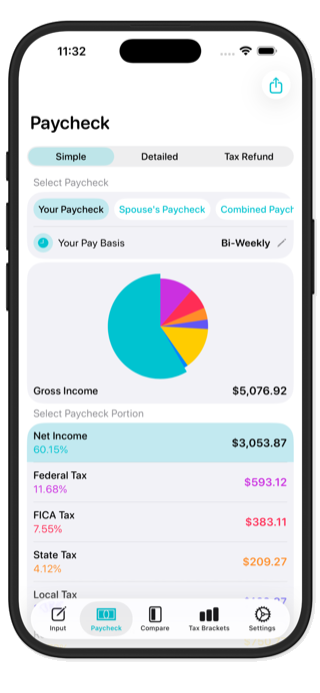
See your real take-home pay down to the penny. Federal taxes, state taxes, local taxes, FICA, retirement contributions, stock compensation — we calculate it all. For all 50 states. For tax years 2021 through 2026.


Enter your details for an instant estimate
2026 Tax Year
Enter your salary to see your
estimated take-home pay
Most calculators give you a rough estimate. We give you the full picture — every tax, every deduction, every dollar accounted for.
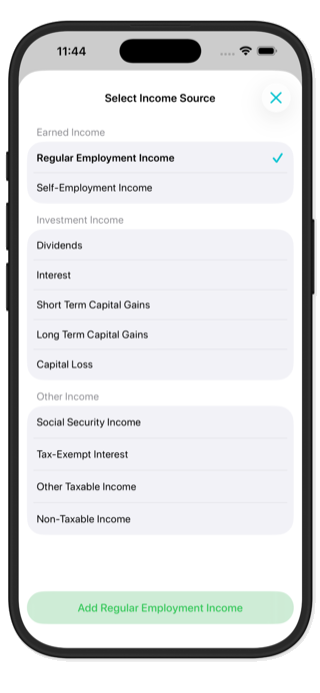
Calculate take-home pay for any income type — salary, hourly, self-employment, tips, and more. See your net pay per paycheck with every tax and deduction accounted for.

Federal income tax, state income tax, Social Security, Medicare, Additional Medicare Tax, and Net Investment Income Tax — all calculated with the actual IRS brackets for your filing status and tax year.

NYC income tax, Yonkers surcharge, Indiana county taxes, Maryland county taxes, Colorado city occupational privilege taxes, Missouri, Oregon, Michigan, and more — 14 states with local tax support.

ISOs, NSOs, and RSUs — calculate the real tax impact of your equity compensation. See how exercising stock options or vesting RSUs affects your take-home pay and tax bracket.

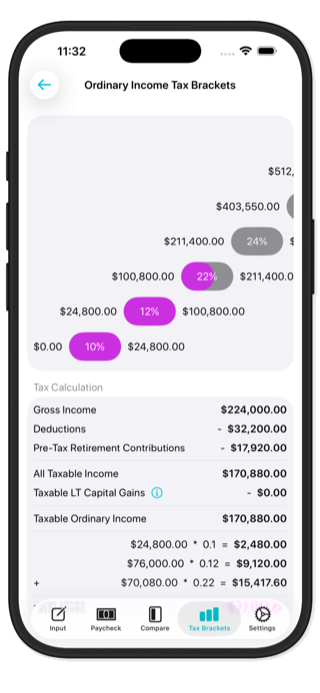
See exactly where you fall in each tax bracket. Visual bar charts show how your income is taxed at each marginal rate — federal, state, FICA, capital gains, and NIIT.

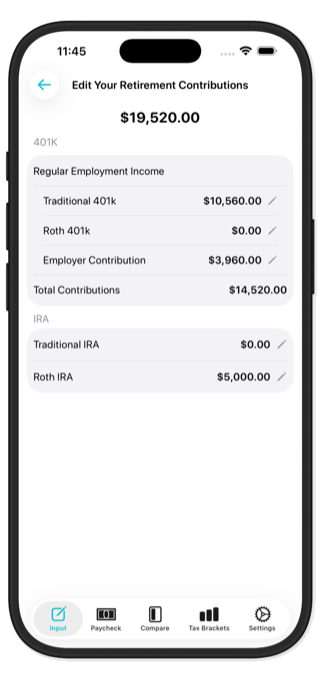
Traditional 401(k), Roth 401(k), Traditional IRA, Roth IRA, employer match — see how each contribution affects your take-home pay. Automatic contribution limit enforcement by age and year.

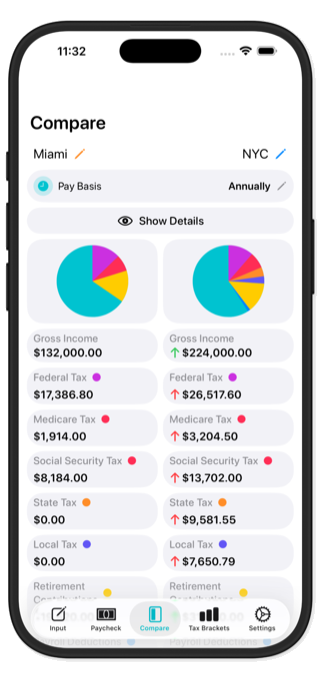
Considering a job in a new state? Negotiating a raise? Compare two complete tax scenarios side by side — see exactly how much more (or less) you'll take home.

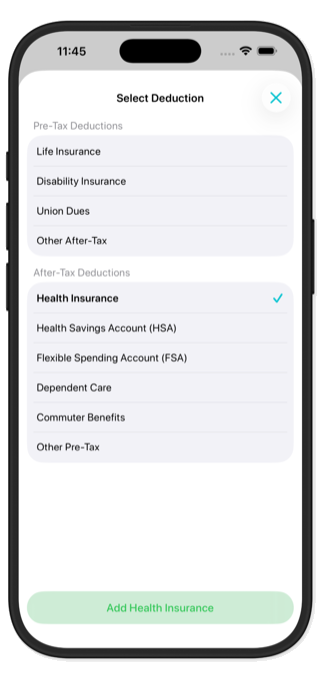
Standard vs. itemized (federal and state separately), SALT cap, mortgage interest, charitable, HSA, FSA, health insurance, car loan interest (BBBA 2025), and capital loss carryover.

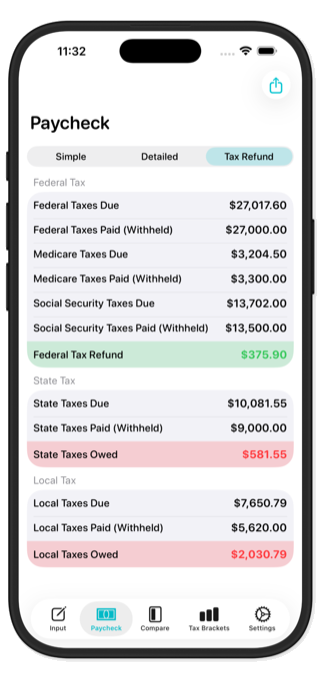
Enter your withholdings and see whether you'll get a refund or owe money — broken down by federal, state, and local. No surprises at tax time.

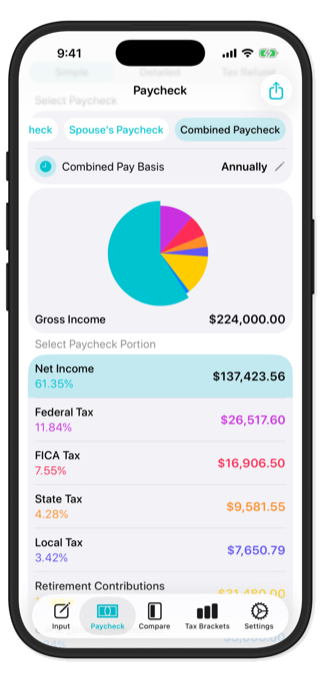
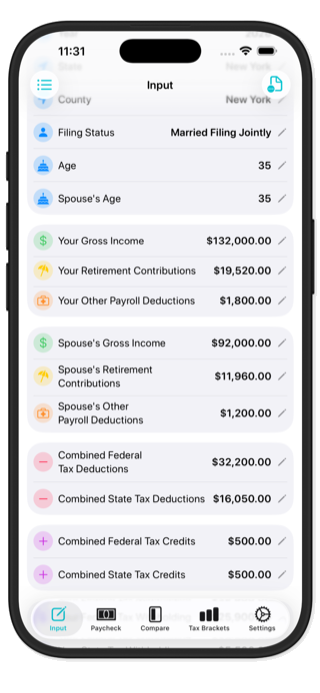
Full support for couples filing jointly or separately. Enter both spouses' incomes, deductions, and retirement contributions — see individual and combined take-home pay.

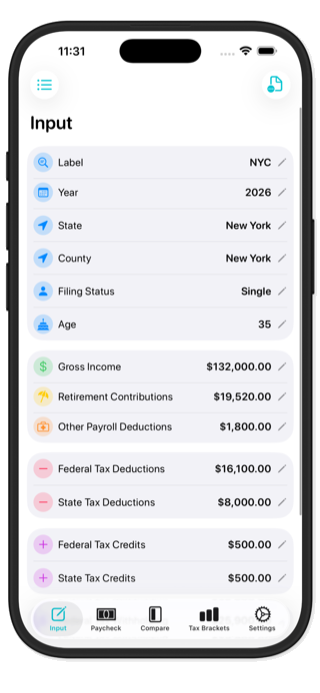
Filing status, state, income, deductions, retirement contributions. The app walks you through everything — you don't need to be a tax expert.
Instantly see your take-home pay with a full breakdown of every tax and deduction. Switch between annual, monthly, bi-weekly, weekly, daily, or hourly views.
Adjust contributions, compare job offers in different states, model a raise — see exactly how every change affects your bottom line.
No other paycheck calculator covers this much.
My Paycheck Calculator was built because understanding your paycheck shouldn't require a CPA. The tax code is complicated — your calculator shouldn't be.

Free to download. No account required. Your data never leaves your device.
Download on App StoreAvailable on iPhone and iPad · iOS 17+
Calculate your take-home pay with accurate state and local tax rates
Your paycheck is calculated by starting with your gross income and subtracting federal income tax, state income tax, local taxes (if applicable), Social Security tax (6.2%), Medicare tax (1.45%), and any pre-tax deductions like 401(k) contributions or health insurance premiums. The result is your net or take-home pay.
Common paycheck deductions include: Federal income tax (10-37% based on income and filing status), State income tax (0-13.3% depending on state — 9 states have no income tax), FICA taxes (Social Security at 6.2% up to $176,100 and Medicare at 1.45%), and local/city taxes in some jurisdictions.
To calculate take-home pay: 1) Start with your gross salary or hourly wage times hours worked, 2) Subtract federal income tax using your W-4 filing status and the 2026 tax brackets, 3) Subtract state income tax for your state, 4) Subtract FICA taxes (7.65% for most workers), 5) Subtract any pre-tax deductions. Use our free paycheck calculator above to do this automatically for all 50 states.
FICA stands for Federal Insurance Contributions Act. It includes two taxes: Social Security tax (6.2% on income up to $176,100 in 2026) and Medicare tax (1.45% on all income, plus an additional 0.9% on income over $200,000). Your employer matches these amounts, so the total FICA rate is 15.3%.
Nine US states have no state income tax: Alaska, Florida, Nevada, New Hampshire (dividends and interest only), South Dakota, Tennessee, Texas, Washington, and Wyoming. Residents of these states keep more of their paycheck since only federal and FICA taxes apply.